New York anglers have learned a hard truth over the decades: when Chesapeake recruitment runs hot, the Northeast benefits down the road. When Chesapeake recruitment runs cold for multiple years, we eventually feel it as thinner age structure and “missing classes,” even if the bite can still look decent in the short term.
And it’s not just the Chesapeake. The New York State DEC has also been ringing the bell on Hudson River reproduction. In its 2026 update, DEC notes that the Hudson and Chesapeake combined contribute a huge share of the coastwide stock and warns that ongoing poor juvenile production has real long-range consequences for abundance and management. [Source](https://dec.ny.gov/news/press-releases/2026/2/dec-issues-update-on-hudson-rivers-atlantic-striped-bass-reproductive-success)
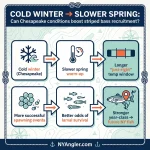
If spring warms too quickly, that “good zone” can be short and jumpy. If spring warms gradually, that window may stay open longer—more chances for successful spawning events, and fewer rapid swings that can hammer early survival.
Cold helps the setup. Spring decides the outcome. Graphic created for NYAngler.com.
Maryland DNR has repeatedly highlighted that environmental conditions—especially warmer, drier winters and decreased spring water flow rates—are likely driving forces behind the Bay’s recent stretch of poor spawning success. [Source](https://news.maryland.gov/dnr/2023/10/17/warm-winters-low-water-flow-are-leading-factors-in-poor-striped-bass-spawn/)
So the most honest version of the “cold winter boom” question is really a two-part question:
For New York anglers, that means Chesapeake year-classes are basically a delayed deposit into our future fishing. We don’t cash it immediately—but we do cash it.
And it’s not just the Chesapeake. The New York State DEC has also been ringing the bell on Hudson River reproduction. In its 2026 update, DEC notes that the Hudson and Chesapeake combined contribute a huge share of the coastwide stock and warns that ongoing poor juvenile production has real long-range consequences for abundance and management. [Source](https://dec.ny.gov/news/press-releases/2026/2/dec-issues-update-on-hudson-rivers-atlantic-striped-bass-reproductive-success)
So… will a cold winter help the striped bass spawn?
Maryland DNR has been cautiously optimistic about one idea: a cold winter may slow the spring warm-up in Chesapeake tributaries where striped bass spawn, potentially creating a longer stretch of suitable temperatures for spawning and early survival. [Source](https://news.maryland.gov/dnr/2026/02/05/secretarys-message-cold-winter-could-boost-prospects-for-striped-bass/)Cold can set the table. Spring still has to deliver the meal.
Spawn vs. recruitment: what “help the spawn” really means
Anglers say “the spawn” like it’s one event. From a recruitment standpoint, it’s a chain—and every link matters:- Adults have to spawn successfully (timing, location, conditions).
- Eggs have to develop and hatch under tolerable conditions.
- Larvae have to survive the first critical weeks.
- Juveniles have to make it through their first summer and show up in surveys.
Why winter temperature can matter: the “window” problem
Striped bass don’t spawn because the calendar says so—they spawn when spring water temperatures rise into a favorable range. Maryland DNR notes that spawning is triggered by rising spring temperatures and emphasizes how critical the temperature window is during spawning and the first weeks of larval life. [Source](https://news.maryland.gov/dnr/2026/02/05/secretarys-message-cold-winter-could-boost-prospects-for-striped-bass/)If spring warms too quickly, that “good zone” can be short and jumpy. If spring warms gradually, that window may stay open longer—more chances for successful spawning events, and fewer rapid swings that can hammer early survival.
The deal-breaker is often flow: cold winter isn’t the whole story
If winter temperature is the setup, freshwater flow is often the deciding factor.Maryland DNR has repeatedly highlighted that environmental conditions—especially warmer, drier winters and decreased spring water flow rates—are likely driving forces behind the Bay’s recent stretch of poor spawning success. [Source](https://news.maryland.gov/dnr/2023/10/17/warm-winters-low-water-flow-are-leading-factors-in-poor-striped-bass-spawn/)
So the most honest version of the “cold winter boom” question is really a two-part question:
- Does spring warm up gradually—or does it spike fast?
- Do Chesapeake tributaries get a wet spring with sustained flow—or another low-flow season?
Why New York anglers should track this (even if the bite is good right now)
Striped bass are managed coastwide by the Atlantic States Marine Fisheries Commission (ASMFC). ASMFC’s species overview lays out the big picture: stripers spawn in river systems, spend early life in nurseries, then join the coastal migratory population that mixes along the Atlantic coast. [Source](https://asmfc.org/species/atlantic-striped-bass/)For New York anglers, that means Chesapeake year-classes are basically a delayed deposit into our future fishing. We don’t cash it immediately—but we do cash it.
The NYAngler.com reader challenge for this spring
Here’s what I want New York anglers to do with this question—because it’s actionable, and it keeps us focused on the right signals instead of just the hype:- Watch the warm-up: does spring ramp gradually, or spike fast?
- Watch rainfall and river flow: are Chesapeake tributaries getting sustained spring discharge?
- Watch for temperature whiplash: big swings can be brutal during the early-life window.