There goes the
Market Price of my beloved fried clams...
Midcoast shellfish harvesters bogged down by deadly algae bloom
The bloom appears to be easing in certain parts of Casco Bay, but low oxygen levels could lead to even more dead species.
Shellfish harvesters expecting a bountiful season are now assessing their losses and bracing for what’s next after an algae bloom wiped out most of the stock in certain Midcoast bays.
Town and state officials, along with scientists and shellfish harvesters, have been monitoring a significant bloom of the phytoplankton Karenia mikimotoi after it was
detected in Casco Bay earlier this month.
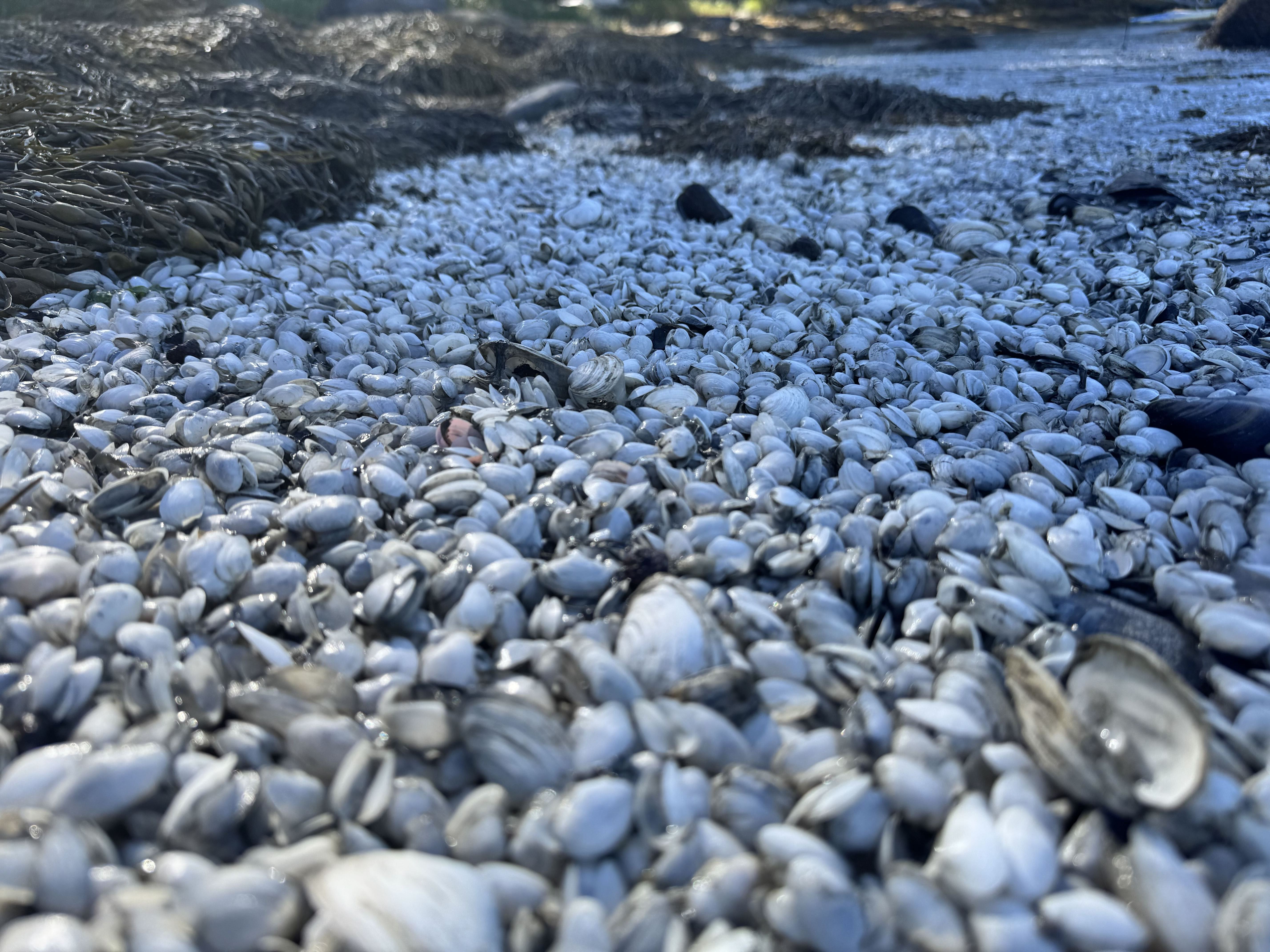
The algae bloom, which is not harmful to humans, spurred the Department of Marine Resources last week to close shellfish harvesting in Maquoit Bay in Brunswick and the eastern side of Middle Bay in Harpswell, where clam diggers noticed dramatic die-offs of softshell clams and worms.
More closures could be coming as the bloom shifts to other areas, coastal resource managers in Brunswick and Harpswell said.
“You couldn’t put a number on the generational shell stock that we’ve lost,” said David Wilson, a Harpswell-based harvester. Wilson alerted authorities to the issue after noticing a large concentration of foul-smelling dead species in Middle Bay in Harpswell earlier this month.

Dead clams pile up in Maquoit Bay in Brunswick in a photo taken by town Coastal Resource Manager Dan Devereaux (Courtesy of Dan Devereaux)
K. mikimotoi puts significant stress on shellfish, impacting their ability to feed and breathe. If shellfish aren’t killed by the algae itself, they may be suffocated as the bloom depletes the amount of oxygen in the water.
The bloom appears to be breaking up in Maquoit and Middle bays, but more die-offs are expected because of low dissolved oxygen, said Darcie Couture, Harpswell’s harbormaster and marine resource administrator. In addition, dead species and low dissolved oxygen levels are beginning to appear along the upper New Meadows River and Thomas Point Beach.
“Things with this current event are evolving literally hour-by-hour,” Couture said Tuesday.
In
an update Wednesday, the Maine Department of Marine Resources said the bloom appears to be moving into the Penobscot Bay area between Owls Head, Northport and Islesboro. A dense patch of the phytoplankton was also reported south of Vinalhaven.
High nor’easter winds this weekend could shift the bloom to different areas, Brunswick and Harpswell officials said.
Meanwhile, the National Oceanic and Atmospheric Administration
has mapped an active phytoplankton bloom extending from northern Massachusetts all the way up the coasts of New Hampshire and Maine.
The event is expected to have a huge financial impact on local shellfish harvesters, who, before the bloom, were having a very productive year in the Brunswick area, according to Brunswick Coastal Resource Manager Dan Devereaux.
Devereaux’s office counted 66,000 bushels of harvestable softshell clams last fall along Brunswick’s coastline. In a typical year, the harvestable crop would be about 4,500 bushels, he said.
Brunswick is already a productive clamming port. In 2025,
harvesters in Brunswick collected nearly 455,000 pounds of softshell clams and made $1.8 million, more than any other softshell clam port in Maine that year, according to the Department of Marine Resources.
“This is the biggest mortality event I’ve ever seen along the Brunswick shores and in particular in Maquoit Bay, but it’s also the most dense I’ve ever seen softshell clams in this town,” Devereaux said.
Harvesters are now struggling to stay afloat.
Wilson’s been a commercial clammer for 36 years, and has also done aquaculture work. Wild harvesting clams allowed Wilson to buy land in Harpswell and raise his kids, he said. He loves it, but the variability of year-to-year conditions makes it difficult. This month’s events have caused him to make tough financial decisions, like putting off trading in his truck.
He’s finding places to dig, but it is a “fraction” of what he would produce just weeks ago.
“I’m at a loss of words,” Wilson said Wednesday.
Devereaux said the bloom may also cause stressed oysters to close up, meaning they won’t feed enough to survive the winter. Lobsters could move out of the bays, too, due to low oxygen levels.
“The priceless thing that we can’t put on it is, how much ecological trickle-down damage does this have?” Devereaux said.
K. mikimotoi is naturally occurring, but has only appeared in Maine in the last decade, according to Nick Record, a senior research scientist at the Bigelow Laboratory for Ocean Sciences. The last time a bloom of the species impacted Casco Bay was in 2017, according to the the Department of Marine Resources.
The laboratory tracks harmful new arrivals like K. mikimotoi — which could have been brought over in the bilges of ships, or by changing currents.
“Harmful algal blooms have been with us as long as we remember,” Record said. But climate change has likely dialed up the frequency of new species popping up in Maine.
“We need to be expecting surprises,” he said.
Harvesters like Wilson have been collecting shellfish samples to send off for testing. Couture, the Harpswell harbormaster, hopes that this event helps scientists predict blooms earlier in the future.
The full impact will become apparent after the bloom moves out of the area, Devereaux said, but he guesses that harvesters have lost millions of dollars.
“We’ll be able to go back this fall and really see how the biomass of softshell clams has shrunk and then put some economic numbers to that pretty accurately,” he said.
The Department of Marine Resources is asking those in the industry to report signs of low oxygen, water discoloration and odors. The department will share updates on the situation
on its website.