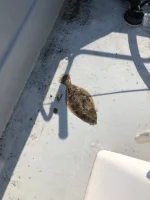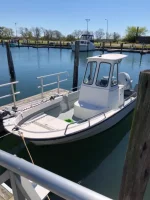
Post your 2019-2025 Fluke Pix & Trip Reports Here!

Well, its that time of the year yet again. Time to get going on needed repairs, upgrades, maintenance and Spring Prep.

So, last Fall I wrote that I thought I had an exhaust manifold leak - turns out I had two, one on each side. Geez, I can't believe that it was such a minor sound, given what I found today.

Got busy pulling the old, used-up exhaust system off the block. And it turns out my diagnosis was correct.

Port side #8 exhaust port - badly burned/corroded from whatever nasty stuff the engine generates. This is the tapping I heard at idle:

Port #8.webp


But look at Starboard side #4, even worse! And yet I never heard a thing on that side of the motor.

Strdbd #4 .webp


Of course being a gas inboard with the exhaust manifold bolts below deck level, this knowledge does not come without some expense, and I don't just mean monetary-wise, thought that's also pretty nasty.

Ouch!.webp


Just the price that must be paid to keep her in shape to find those ocean fluke this coming season. On the old Shamrock Owner's board we used to say "any job worth doing is worth leaving a little bit of yourself in the bilge."

Truer words were never spoken.
 
BTW, How many hours did you get out of the old manifolds?

Hah, good question! 10 minutes for each of the risers. One hour on the port side manifold. Not bad, considering the last four bolts have to be done by feel alone. The starboard side manifold, one hour to get out 7 of the eight bolts. The last, rear-most bolt, another hour plus.

Just can no longer contort my body enough to wedge my average-length arm back there from the front of the engine, as getting to it from the side is impossible - for me. Another example of getting too old for this, um, "stuff." I cannot image doing this for a living. Mad respect for marine mechanics everywhere - makes automotive repair look like a walk in the park.

One helpful tip is to NOT use the factory BS iron bolts that are OEM. They corrode badly, rust-freeze in the heads despite using liberal quantities of Never-Seize, making a tough job even tougher. Anyone in the know uses stainless steel "cap screws," with a good-quality 3/8" hex-drive socket - mine is Snap-on, of course! Still not a job I will ever look forward to, but these make it just a wee bit "better."

Also, always use fresh grade-8 lock washers every time the manifolds get changed - which according to universal gas inboard ritual thinking is at 6-year intervals.

One other tip - be a bit of a masochist. It kinda helps.

bolt.webp


Bolt2.webp
 
BTW, How many hours did you get out of the old manifolds?

Sorry, I misread your question before having my morning high-test. Yeah, well irrespective of hours run, the risers need changing out every three seasons (easy job), and both the risers and manifolds have to go at six seasons. Sitting or running the internal rust never sleeps, so the safe bet is at those intervals.

This is mandatory with a "half-closed" FW cooling system, because the cast iron mani/risers route the SW out through the exhaust pipes. This is different than a "closed" system, which includes the manifolds in the FW side of the cooling system. Most gas inboards are like mine, half-closed system.

Examples of the "full" system would be the Mercruiser Horizon series and I think some of the higher-end Crusaders. The down side of this cooling method is that the oversized engine heat exchanger must be watched like a hawk, and fully serviced or replaced when running temps move upward even a tiny bit - assuming that the RW pump has been regularly serviced as well. The H/Ex in these Full systems carries a very heavy load, considering they have to cool the engine AND the manifolds.

I think my half-system is better, but that's just my way of thinking. I'll trade-off more grunt work to eliminate possibly cooking the engine, should the H/EX clog or perforate 20 miles from the dock.

There do exist certain types of Stainless Steel riser/manifold setups - usually one piece. Locally there is a custom exhaust fabricator in Farmingdale that can build a set of SS (or copper) exhausts. My friend had a copper set on his Shammie, sister to mine w/the same PCM/Ford engine. For some reason those copper manifolds with an SS bolt-thru flanges would blow out their exhaust gasket every couple of seasons. I think it was a thermal expansion mis-match between the cast iron engine block and the SS manifold flanges, but we never did get to the bottom of that particular issue. He passed away at the age of 53 from a massive heart attack. Another of my closest friends gone forever.

Anyway, that was the $5 course in gas inboard marine exhausts. Congrads, you got an "A".
 
My era of manufacture was available with a small-ish Perkins diesel. I've never seen or even heard of one actually being delivered. There have been a few gas to diesel conversions to Cummins 210hp diesels.

I can't see that sort of swap for reasons of cost, maintenance and the fact that such an engine will put the deck scuppers at or below waterline level. Not to mention a 26-ft boat 8-ft beam boat with a transplanted diesel will shake and vibrate excessively. Just not enough boat to absorb that much engine's drama.

Now if you just happen to have a Cummins out of a Ram pickup laying around and know how to (and can afford) to add marinization, want to replace the BW 71C with a 72C or other beefy transmission, along with a different length and diameter driveshaft and a $1500 prop, reinforce the stringers and completely redo the engine-mounting pads, have no problem modifying the cutlass bearing size in the glass/silica sand poured keel, don't mind the deck not being bailable because the scupper plugs always have to be used (except maybe underway), and KNOW that you will never see the cost come back to you should you ever sell it - well, maybe then such a swap would be for you!

Yeah, nah, from my point of view boat "hotrodding" to that extent should stay a mental exercise, not a reality. Some things should stay hypothetical. Much less drama and acceptance of eventual personal failure that way. Keep the gas, go fishing, and if you want a diesel boat, save up and buy one designed that way from the beginning . Far more peace of mind if it remains a daydream.

30 years I've owned my boat. Never once has a diesel engine made it into the top 10 (or 20) of my "upgrade wants."
 
My era of manufacture was available with a small-ish Perkins diesel. I've never seen or even heard of one actually being delivered. There have been a few gas to diesel conversions to Cummins 210hp diesels.

I can't see that sort of swap for reasons of cost, maintenance and the fact that such an engine will put the deck scuppers at or below waterline level. Not to mention a 26-ft boat 8-ft beam boat with a transplanted diesel will shake and vibrate excessively. Just not enough boat to absorb that much engine's drama.

Now if you just happen to have a Cummins out of a Ram pickup laying around and know how to (and can afford) to add marinization, want to replace the BW 71C with a 72C or other beefy transmission, along with a different length and diameter driveshaft and a $1500 prop, reinforce the stringers and completely redo the engine-mounting pads, have no problem modifying the cutlass bearing size in the glass/silica sand poured keel, don't mind the deck not being bailable because the scupper plugs always have to be used (except maybe underway), and KNOW that you will never see the cost come back to you should you ever sell it - well, maybe then such a swap would be for you!

Yeah, nah, from my point of view boat "hotrodding" to that extent should stay a mental exercise, not a reality. Some things should stay hypothetical. Much less drama and acceptance of eventual personal failure that way. Keep the gas, go fishing, and if you want a diesel boat, save up and buy one designed that way from the beginning . Far more peace of mind if it remains a daydream.

30 years I've owned my boat. Never once has a diesel engine made it into the top 10 (or 20) of my "upgrade wants."
Thanks for the explanation. I know a friend owned a similar sized Sisu with a small John Deere that ran like a top. Different boat. Different specs.......Best of luck this season.
 
I had a guy in the marina that converted his Shamrock to a diesel. He worked for the marina and did all his own work. Not sure what marina he is at now.

I see him fishing once in a while
 
There was a guy in the slip next to me for many years in the Tuna Club. I think he had 26’ Shamrock, with a small Perkins. I can’t remember the name of the boat, his name was Ron something……. He loved the boat and had canyon fished it back in the day.
 
There was a guy in the slip next to me for many years in the Tuna Club. I think he had 26’ Shamrock, with a small Perkins. I can’t remember the name of the boat, his name was Ron something……. He loved the boat and had canyon fished it back in the day.
Lep, do you remember this boat, FISH HAWK II? This is the boat I was referring to, his name was Ron, he had a slip next to mine. Don’t know if he was a member of your Shamrock Club. He passed away some years ago.
IMG_1070.webp
 
No Matt, I don't recall that boat. But my memory is not what it used to be, so there's that . . .

Looks like he kept a nice clean boat.
 
Pete, welcome to my world on the memory thing. 🤪

Don't sweat that one. We've all known a Captain Ron or two somewhere along the line.

Mine was a wonderful guy that had a Blackfin with a pair of Isuzu diesels that he and I spent months troubleshooting. And when we finally got it working right it burned and sank at the dock. Frankly, I believe the boat committed suicide.

Still one of the finest gentlemen I ever knew.
 
Huzzah!

My heavy mechanical work is now complete! It was a long, tough row to hoe, but it's behind me now.

New factory PCM manifolds and risers, new heat exchanger (Lenco Farmingdale), new starter motor (DB Electric), rebuilt the Sherwood RW pump, new Autolite plugs, factory PCM plug wires, Pertronix cap and rotor. Fresh Prestone antifreeze fill. Oil & filter change (Castrol 20W-50 with a half-pint of STP and a Wix max filter) done before the shrink-wrapping last December. Replaced some suss hoses and clamps, re-did my main bilge pump fixturing, had my office 3D print a structural truss for the engine compartment forward bulkhead, removed any rustiness from engine and trans and gave them a fresh touch-up of black Rustoleum. This all took a ton of effort, not to mention a good bit of donated skin and blood, but it's done. Now onto my "normal" Spring prep.

A few new "tricks" I've added this time around. First, it's really tough to get at the 4 rear-most bolts of each manifold and those 4 rear spark plugs, for that matter too. At 70 years old now, not only can I no longer contort my body sufficiently to reach back there whilst laying atop the engine, but I think my arms got shorter too. I don't know if that's medically possible, but it is what it is. So, I took out the big stainless motor mount lag bolts and put a "cheapie" Harbor Freight 8-ton hydraulic bottle jack under the motor mount, each side in turn. OMG, why did it take me 30 years of ownership to remedy this nightmare? Dense, I guess.

IMG_7526.webp


This made all the difference, that's for sure. Just had to make sure that the "down-load" on the inside of hull was well distributed with 1x6 board. Each mount (there are 4, including the trans mounts) carries about 300lbs of weight, so gotta be a little careful with this plan of action. Didn't hear any cracking, so good to go.

Instead of doing the aforementioned near impossible "by blind feel" method, I could now use a simple 12" 3/8" extension, swivel and hex-driver from the side of the deck to R&R those torture-inducing rear-most manifold stainless cap screws. This was huge!

IMG_7530.webp


And here's the most important (and least expensive) "tool" for this type of work, which I figured out half-way thru the work -

gloves.webp


Just a cheap pair of cotton work gloves, with the fingers cut off. Again, OMG, what a difference! No more deep scratches on the backs of my hands from wire tie cut-offs and assorted other nasties. Hey, dropping an American V-8 into a boat with an 8-foot beam has some truly great advantages. The other side of the coin is that access to bolts, hose clamps, etc, is at shall we say, a "premium." the glove solution made it MUCH more comfortable to reach down, in, and around all the pain inducing hand-snaggers.

And now she sits, ready to fire. That will happen some time this coming week, as today my wife graciously allowed me to use up "her" day's morning to complete this work.

Fingers crossed.

IMG_7552.webp
 

Fishing Reports

Latest articles

Back
Top