
A reel you can explore—not just read about
The 2026 Daiwa BG SW won ICAST’s Saltwater Reel category. Here is what is confirmed, what Daiwa claims, what remains unknown, and why each system matters to Northeast anglers.
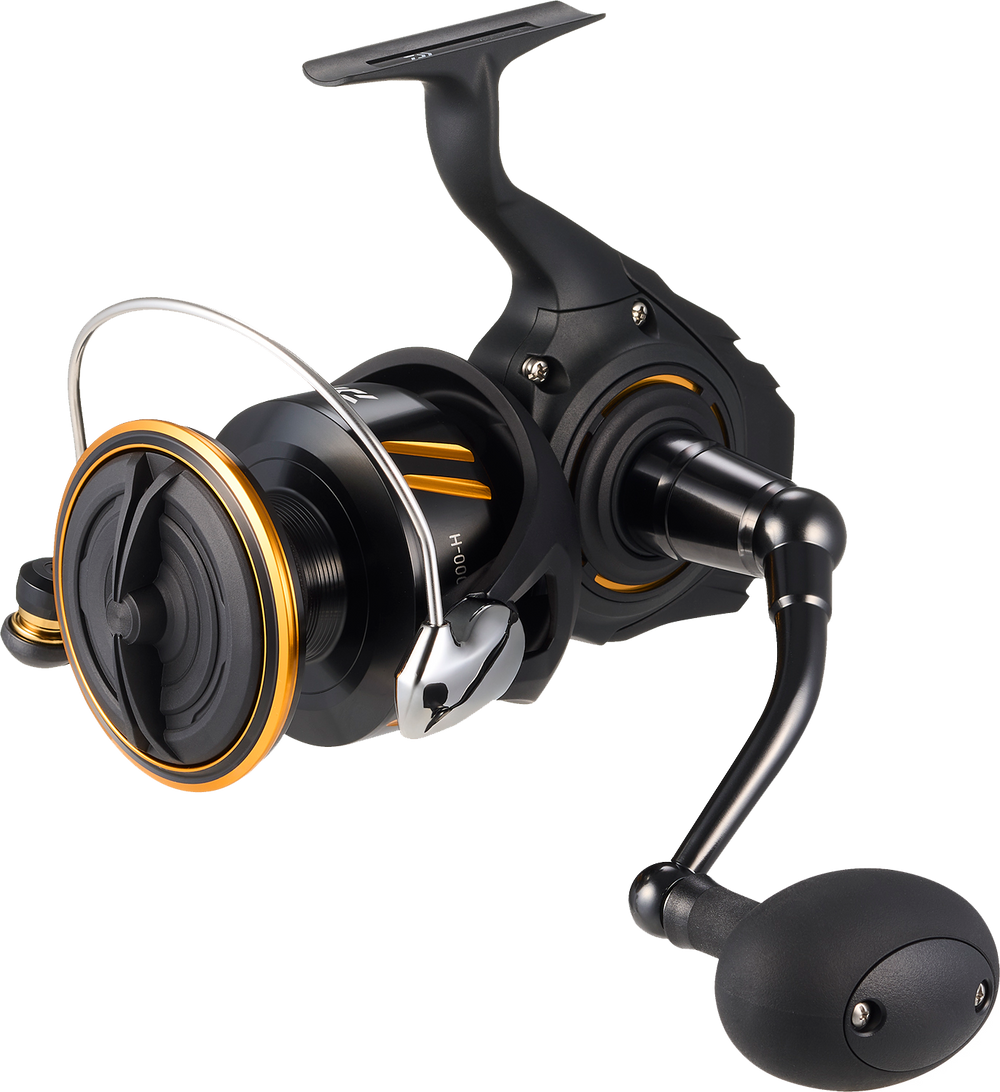
Official Daiwa product image of the 2026 BG SW 14000-H. Image: Daiwa US.
VERIFIED FACT — Confirmed by ICAST or an official Daiwa product page.
MANUFACTURER CLAIM — Daiwa’s description of intended performance. NYAngler has not yet independently bench-tested the reel.
ILLUSTRATIVE — A plain-English explanation of how a spinning-reel system generally works. It is not a factory service diagram of this model.
CURRENT CONFIDENCE: REFERENCE-BASED — The reel, specifications, named systems and visible assemblies are documented. As of July 27, 2026, NYAngler has not located an official 2026 BG SW exploded service schematic or numbered parts list. We will not invent one.
JUMP TO: Anatomy · Northeast size map · Update roadmap · Sources
VERIFIED FACT: The American Sportfishing Association’s ICAST New Product Showcase named the Daiwa 2026 BG SW the 2026 Best of Category winner for Saltwater Reel. That is a category award—not ICAST’s single overall Best of Show award.
For NYAngler readers, it is an unusually relevant winner. The BG SW line is aimed at heavy saltwater work, from surf and shore casting to jigging and offshore applications. Daiwa’s U.S. page lists a starting MSRP of $199.99, while noting that prices may change.
The redesign is built around Daiwa’s Powerdrive Design. The official U.S. description names three headline systems: an oversized Power Digigear, a reinforced Powerdrive Rotor and a Crank Power Bail. It also lists an aluminum body, ATD drag and a machined aluminum handle.
Each section below separates what the hardware does from what has—and has not—been independently verified. The current CMS presents these as readable component cards; a future schematic release will enable precise part-level hotspots.
What you are looking at
The spool stores line but does not spin during a cast. Line peels over the spool lip while the bail is open. During retrieval, the rotor and line roller orbit the spool as the spool moves in and out to distribute line.
VERIFIED FACT: Daiwa describes the 2026 BG SW spool as braid-ready and gasket-lined. The U.S. product page says the surface lets braid attach without monofilament backing.
MANUFACTURER CLAIM: Daiwa’s Japanese product material attributes its LC-ABS SW spool geometry to improved casting performance. Any percentage improvement is a controlled manufacturer comparison—not an NYAngler field result.
ILLUSTRATIVE LIMIT: Without the model-specific service drawing, we cannot yet map every washer, retainer or seal below the spool.
What it does
The drag lets the spool rotate under load so a fish can take line without instantly breaking the line or pulling the hook. A well-behaved drag should begin releasing smoothly and stay consistent as heat builds.
VERIFIED FACT: Daiwa identifies the system as ATD Tough and says it uses carbon drag washers.
MANUFACTURER CLAIM: Daiwa says the system is engineered for smooth, sustained pressure and durability.
NOT YET VERIFIED: NYAngler has not measured startup force, drag fade, heat behavior or usable maximum drag on a production reel. Those figures will belong in a future instrumented test—not in a paraphrase of marketing copy.
What it does
The rotor turns around the stationary spool. It carries the bail arms and line roller, taking line from the roller and wrapping it onto the oscillating spool.
VERIFIED FACT: Daiwa describes a reinforced composite rotor and a Crank Power Bail. The Japanese page says the cranked bail shape and stronger spring mechanism are intended to guide tensioned line toward the line roller and reduce unintended opening or closing.
MANUFACTURER CLAIM: Daiwa says the reinforced rotor resists flex at the line roller under heavy drag pressure.
ANGLER NOTE: Daiwa’s published material says the 2026 BG SW uses manual bail return. Closing a heavy spinning reel by hand can also reduce the habit of cranking the handle to slam the bail shut.
What it does
Turning the handle rotates the main drive gear. The drive gear turns the pinion, which drives the rotor. This is the central power path:
HAND → HANDLE → DRIVE GEAR → PINION → ROTOR → LINE ROLLER → LINE
VERIFIED FACT: Daiwa’s Japanese product page says the drive gear has been increased in diameter and thickness and uses revised tooth geometry.
MANUFACTURER CLAIM: Daiwa says those changes reduce gear deflection and power loss under sustained load.
ILLUSTRATIVE LIMIT: The power path above is mechanically representative, but the exact tooth count, gear material, dimensions and supporting hardware should wait for service documentation or a measured teardown.
What it does
The oscillation mechanism moves the spool shaft forward and backward while the rotor wraps line. Its job is even line lay, which affects capacity, casting behavior and how cleanly the next layer leaves the spool.
VERIFIED FACT: Daiwa’s Japanese page lists five stainless-steel ball bearings: two supporting the pinion, two supporting the drive gear and one supporting the oscillation gear. The published specification table also lists a roller bearing separately as “5/1.”
NOT YET VERIFIED: Daiwa’s broader Powerdrive literature covers multiple technologies. We are not assuming every Powerdrive feature used on another model appears in this BG SW unless the 2026 BG SW documentation says so.
What it does
The body holds the drivetrain in alignment. Under load, rigidity matters because gear mesh can suffer if the housing twists.
VERIFIED FACT: Daiwa’s U.S. page describes an aluminum frame and body cover with a gasket seal. ICAST’s winner page also refers to a gasket-sealed frame.
LANGUAGE CHECK: Official promotional copy uses the word “waterproof.” NYAngler is using the more precise phrase gasket-sealed water-resistant design until ingress protection is independently tested. A fishing reel has multiple potential entry points and should not be treated as submersible based on a product-page adjective.
What it does
The handle is where the angler applies torque. A larger, grippy knob can improve control with wet hands and during long fights.
VERIFIED FACT: Daiwa lists a machined aluminum handle and an egg-shaped power knob. Published Japanese specifications show 65 mm handle arms on the 5000 and 6000 sizes, 75 mm on the 8000 through 14000 sizes, and 85 mm on the 20000.
MANUFACTURER CLAIM: Daiwa says the knob shape improves leverage, grip and comfort. Those are testable ergonomic claims; NYAngler has not yet conducted a comparative fatigue test.
The following is an editorial use-case map, not a universal prescription. Rod power, lure weight, line diameter, target size, current and angler preference all matter.
5000-H / 6000-H
6000-P / 8000-P
8000-H / 10000-H / 14000-H
20000
VERIFIED FACT: Daiwa Japan currently lists eight models from 5000-H through 20000. The 5000–14000 models are shown for October 2026 release in Japan, with the 20000 shown for November 2026. U.S. availability and final U.S. model selection may differ.
Line capacities are intentionally not collapsed into a single recommendation here. Daiwa publishes nylon, fluorocarbon and PE capacities, but actual braid diameter varies by manufacturer and packing tension.
This is a living product anatomy. Its next versions should add evidence, not simply more animation.
When the official schematic appears
When NYAngler obtains a production reel
When reader reports arrive
This version is designed to remain useful without motion, sound or hover. The official reel image scales to the reader’s screen; every anatomy section is available as a tap- or keyboard-opened text card; the full explanation is readable even if images fail to load. A future animated version should honor reduced-motion settings and retain this static article as its fallback.
The 2026 BG SW is a legitimate ICAST saltwater-reel category winner with a clearly documented redesign. The oversized gear, reinforced rotor, cranked bail, carbon drag, five-bearing support map and gasketed aluminum body are real published features. Claims about smoother drag, reduced flex, lower power loss, longer casting or better comfort remain manufacturer claims until someone measures them.
That distinction is the point of this page. NYAngler’s living product anatomy will get more detailed as the evidence gets better—and it will show readers exactly where the line sits between fact, claim and illustration.
Editorial disclosure: NYAngler has not stated or implied that this article is sponsored, and no hands-on test is claimed. The external links above are source references, not an endorsement of every promotional statement on those pages.
The 2026 Daiwa BG SW won ICAST’s Saltwater Reel category. Here is what is confirmed, what Daiwa claims, what remains unknown, and why each system matters to Northeast anglers.
Official Daiwa product image of the 2026 BG SW 14000-H. Image: Daiwa US.
How to read this living article
VERIFIED FACT — Confirmed by ICAST or an official Daiwa product page.
MANUFACTURER CLAIM — Daiwa’s description of intended performance. NYAngler has not yet independently bench-tested the reel.
ILLUSTRATIVE — A plain-English explanation of how a spinning-reel system generally works. It is not a factory service diagram of this model.
CURRENT CONFIDENCE: REFERENCE-BASED — The reel, specifications, named systems and visible assemblies are documented. As of July 27, 2026, NYAngler has not located an official 2026 BG SW exploded service schematic or numbered parts list. We will not invent one.
JUMP TO: Anatomy · Northeast size map · Update roadmap · Sources
Why this reel matters
VERIFIED FACT: The American Sportfishing Association’s ICAST New Product Showcase named the Daiwa 2026 BG SW the 2026 Best of Category winner for Saltwater Reel. That is a category award—not ICAST’s single overall Best of Show award.
For NYAngler readers, it is an unusually relevant winner. The BG SW line is aimed at heavy saltwater work, from surf and shore casting to jigging and offshore applications. Daiwa’s U.S. page lists a starting MSRP of $199.99, while noting that prices may change.
The redesign is built around Daiwa’s Powerdrive Design. The official U.S. description names three headline systems: an oversized Power Digigear, a reinforced Powerdrive Rotor and a Crank Power Bail. It also lists an aluminum body, ATD drag and a machined aluminum handle.
Explore the reel: system-by-system anatomy
Each section below separates what the hardware does from what has—and has not—been independently verified. The current CMS presents these as readable component cards; a future schematic release will enable precise part-level hotspots.
1 · Spool, drag knob and line management
What you are looking at
The spool stores line but does not spin during a cast. Line peels over the spool lip while the bail is open. During retrieval, the rotor and line roller orbit the spool as the spool moves in and out to distribute line.
VERIFIED FACT: Daiwa describes the 2026 BG SW spool as braid-ready and gasket-lined. The U.S. product page says the surface lets braid attach without monofilament backing.
MANUFACTURER CLAIM: Daiwa’s Japanese product material attributes its LC-ABS SW spool geometry to improved casting performance. Any percentage improvement is a controlled manufacturer comparison—not an NYAngler field result.
ILLUSTRATIVE LIMIT: Without the model-specific service drawing, we cannot yet map every washer, retainer or seal below the spool.
2 · ATD Tough carbon drag
What it does
The drag lets the spool rotate under load so a fish can take line without instantly breaking the line or pulling the hook. A well-behaved drag should begin releasing smoothly and stay consistent as heat builds.
VERIFIED FACT: Daiwa identifies the system as ATD Tough and says it uses carbon drag washers.
MANUFACTURER CLAIM: Daiwa says the system is engineered for smooth, sustained pressure and durability.
NOT YET VERIFIED: NYAngler has not measured startup force, drag fade, heat behavior or usable maximum drag on a production reel. Those figures will belong in a future instrumented test—not in a paraphrase of marketing copy.
3 · Powerdrive Rotor, bail and line roller
What it does
The rotor turns around the stationary spool. It carries the bail arms and line roller, taking line from the roller and wrapping it onto the oscillating spool.
VERIFIED FACT: Daiwa describes a reinforced composite rotor and a Crank Power Bail. The Japanese page says the cranked bail shape and stronger spring mechanism are intended to guide tensioned line toward the line roller and reduce unintended opening or closing.
MANUFACTURER CLAIM: Daiwa says the reinforced rotor resists flex at the line roller under heavy drag pressure.
ANGLER NOTE: Daiwa’s published material says the 2026 BG SW uses manual bail return. Closing a heavy spinning reel by hand can also reduce the habit of cranking the handle to slam the bail shut.
4 · Oversized Power Digigear and pinion
What it does
Turning the handle rotates the main drive gear. The drive gear turns the pinion, which drives the rotor. This is the central power path:
HAND → HANDLE → DRIVE GEAR → PINION → ROTOR → LINE ROLLER → LINE
VERIFIED FACT: Daiwa’s Japanese product page says the drive gear has been increased in diameter and thickness and uses revised tooth geometry.
MANUFACTURER CLAIM: Daiwa says those changes reduce gear deflection and power loss under sustained load.
ILLUSTRATIVE LIMIT: The power path above is mechanically representative, but the exact tooth count, gear material, dimensions and supporting hardware should wait for service documentation or a measured teardown.
5 · Oscillation system and bearing map
What it does
The oscillation mechanism moves the spool shaft forward and backward while the rotor wraps line. Its job is even line lay, which affects capacity, casting behavior and how cleanly the next layer leaves the spool.
VERIFIED FACT: Daiwa’s Japanese page lists five stainless-steel ball bearings: two supporting the pinion, two supporting the drive gear and one supporting the oscillation gear. The published specification table also lists a roller bearing separately as “5/1.”
NOT YET VERIFIED: Daiwa’s broader Powerdrive literature covers multiple technologies. We are not assuming every Powerdrive feature used on another model appears in this BG SW unless the 2026 BG SW documentation says so.
6 · Aluminum body, body cover and water resistance
What it does
The body holds the drivetrain in alignment. Under load, rigidity matters because gear mesh can suffer if the housing twists.
VERIFIED FACT: Daiwa’s U.S. page describes an aluminum frame and body cover with a gasket seal. ICAST’s winner page also refers to a gasket-sealed frame.
LANGUAGE CHECK: Official promotional copy uses the word “waterproof.” NYAngler is using the more precise phrase gasket-sealed water-resistant design until ingress protection is independently tested. A fishing reel has multiple potential entry points and should not be treated as submersible based on a product-page adjective.
7 · Handle and egg-shaped power knob
What it does
The handle is where the angler applies torque. A larger, grippy knob can improve control with wet hands and during long fights.
VERIFIED FACT: Daiwa lists a machined aluminum handle and an egg-shaped power knob. Published Japanese specifications show 65 mm handle arms on the 5000 and 6000 sizes, 75 mm on the 8000 through 14000 sizes, and 85 mm on the 20000.
MANUFACTURER CLAIM: Daiwa says the knob shape improves leverage, grip and comfort. Those are testable ergonomic claims; NYAngler has not yet conducted a comparative fatigue test.
The Northeast size map
The following is an editorial use-case map, not a universal prescription. Rod power, lure weight, line diameter, target size, current and angler preference all matter.
5000-H / 6000-H
- Surf plugs, jigs and larger inshore work
- Striped bass, bluefish and false albacore applications
- The 6000-H is the most versatile first-test candidate for NYAngler because it crosses surf, boat casting and light offshore work
6000-P / 8000-P
- Lower-geared power options for vertical work and sustained load
- A logical place to compare cranking effort against the higher-speed versions
8000-H / 10000-H / 14000-H
- Heavier shore and offshore casting
- Pelagic and tuna-oriented applications, depending on the complete outfit
- The Japanese published table lists 15 kg maximum drag for the 8000, 10000 and 14000 sizes; treat that as a manufacturer specification until measured
20000
- The largest published size
- Japanese specifications list 965 g weight, 5.3:1 gearing, 137 cm retrieve per handle turn and 20 kg maximum drag
Published model specifications
VERIFIED FACT: Daiwa Japan currently lists eight models from 5000-H through 20000. The 5000–14000 models are shown for October 2026 release in Japan, with the 20000 shown for November 2026. U.S. availability and final U.S. model selection may differ.
- 5000-H: 420 g · 5.7:1 · 96 cm/turn · 12 kg max drag
- 6000-P: 455 g · 4.9:1 · 86 cm/turn · 12 kg max drag
- 6000-H: 455 g · 5.7:1 · 101 cm/turn · 12 kg max drag
- 8000-P: 680 g · 4.9:1 · 97 cm/turn · 15 kg max drag
- 8000-H: 680 g · 5.7:1 · 113 cm/turn · 15 kg max drag
- 10000-H: 690 g · 5.7:1 · 121 cm/turn · 15 kg max drag
- 14000-H: 700 g · 5.7:1 · 122 cm/turn · 15 kg max drag
- 20000: 965 g · 5.3:1 · 137 cm/turn · 20 kg max drag
Line capacities are intentionally not collapsed into a single recommendation here. Daiwa publishes nylon, fluorocarbon and PE capacities, but actual braid diameter varies by manufacturer and packing tension.
What NYAngler still needs to learn
This is a living product anatomy. Its next versions should add evidence, not simply more animation.
When the official schematic appears
- Import the numbered diagram and parts list
- Match each callout to its official name and part number
- Add tap targets with keyboard-accessible descriptions
- Connect each schematic part to the system cards above
- Record which reel size the diagram covers and preserve the source date
When NYAngler obtains a production reel
- Measure weight, line lay and retrieve under load
- Record drag startup force, sustained drag and heat behavior
- Document seals and water-entry paths without calling the reel submersible
- Photograph a controlled teardown
- Replace generic internal explanations with verified component photography
- Track salt exposure, maintenance and long-term wear
When reader reports arrive
- Separate field reports from manufacturer claims and NYAngler bench results
- Capture reel size, line, target species, hours of use and maintenance history
- Surface patterns without turning isolated anecdotes into reliability statistics
Accessibility and mobile behavior
This version is designed to remain useful without motion, sound or hover. The official reel image scales to the reader’s screen; every anatomy section is available as a tap- or keyboard-opened text card; the full explanation is readable even if images fail to load. A future animated version should honor reduced-motion settings and retain this static article as its fallback.
Bottom line
The 2026 BG SW is a legitimate ICAST saltwater-reel category winner with a clearly documented redesign. The oversized gear, reinforced rotor, cranked bail, carbon drag, five-bearing support map and gasketed aluminum body are real published features. Claims about smoother drag, reduced flex, lower power loss, longer casting or better comfort remain manufacturer claims until someone measures them.
That distinction is the point of this page. NYAngler’s living product anatomy will get more detailed as the evidence gets better—and it will show readers exactly where the line sits between fact, claim and illustration.
Source notes · last checked July 27, 2026
- ICAST / American Sportfishing Association — 2026 BG SW category-winner page
- Daiwa US — 2026 BG SW product page
- Daiwa US — ICAST 2026 product listing and starting MSRP
- Daiwa Japan — 26 BG SW systems, bearing locations, models and specifications
- Daiwa Japan — ICAST 2026 award announcement
Editorial disclosure: NYAngler has not stated or implied that this article is sponsored, and no hands-on test is claimed. The external links above are source references, not an endorsement of every promotional statement on those pages.


