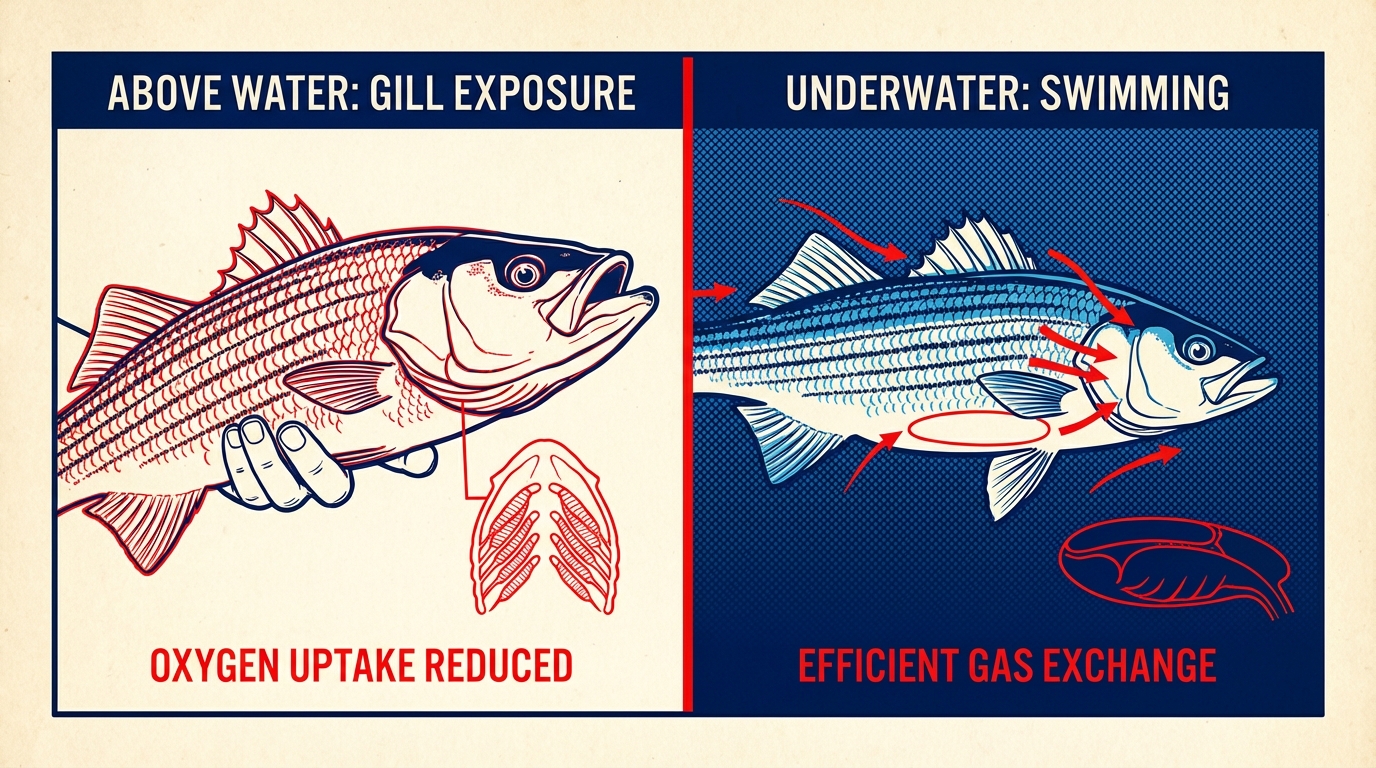
Air Exposure is Critical to Striped Bass C/R Survival!

george

Administrator
Staff member
  • The Critical Variable: Air Exposure​

    The study's most significant finding was the direct correlation between air exposure and recovery time. The results were stark:

    Diagram comparing air exposure effects

    FIG 2.0: PHYSIOLOGICAL IMPACT OF AIR EXPOSURE VS. SUBMERSION
    • 0-10 Seconds Fish kept in the water or exposed to air for less than 10 seconds retained most of their reflexes and recovered quickly.
    • 60 Seconds Fish held out of water for a minute took 8-10 minutes to regain normal swimming patterns.
    • 120 Seconds Fish exposed to air for two minutes never fully recovered within t
 
  • The Critical Variable: Air Exposure​

    The study's most significant finding was the direct correlation between air exposure and recovery time. The results were stark:

    Diagram comparing air exposure effects

    FIG 2.0: PHYSIOLOGICAL IMPACT OF AIR EXPOSURE VS. SUBMERSION
    • 0-10 Seconds Fish kept in the water or exposed to air for less than 10 seconds retained most of their reflexes and recovered quickly.
    • 60 Seconds Fish held out of water for a minute took 8-10 minutes to regain normal swimming patterns.
    • 120 Seconds Fish exposed to air for two minutes never fully recovered within t
That is quite alarming George
2 minutes =0 survival???
 
George
do you have a link to the article?
Article Below:

That is quite alarming George
2 minutes =0 survival???
Yeah, the problem with cut and paste. The study looked at the impact of out of the water time impacted a few reflexes of a striped bass and then how long it took for those reflexes to recover when monitoring the fish for 20 minutes returned to the water. The Amazing AI tool used here clipped said that fish out of water for 2 minutes never recovered those reflexes after 20 minutes. Since those reflexes are critical to survival and eluding predators, the fish's ability to totally recover is impacted.

I'll post a summary of the paper and editorial comments next.
 

Attachments

I assume any posts saying ASMFC has misrepresented striped bass mortality based on the new MA study to be patently FALSE!!

The new release mortality study, O. Dinkelacker, et al, Effects of capture and handling on striped bass (Morone saxatilis) in the recreational fishery of costal Massachusetts, Fisheries Research: 288, that everyone is avoiding reading, but loving to quote as a staunch repudiation of the current, accepted 9% mortality rate for striped bass return is absolutely nothing of the sort. It is a very well designed, executed and analyze study that looks at all the different factors of stress on striped bass that are removed from the water and then returned. The quantitate the stress that the fish undergoes by measuring and recording different reflexes that a fish has and then how long it takes for the fish to recover from the stress. They monitored the fish for 20 min after release and fish out of the water for 2 minutes, most never regained all their reflexes in that 20 minute time. Does this mean they'll die, no one knows, BUT if a seal, sea gull, cormorant, eagle, or other predator were to come along, they'd have an easy meal.

Absolutely nowhere in the publication are the results purported to be considered to replace the current 9% release mortality we've been using. Wait to see what the regs would look like IF people wanted to use their best case scenario!!!

I won't go into details for the short attention spanned challenged here, but here's a summary of what they validated, a bunch of No Shit Sherlock items wit a few exceptions.

Things that negatively impact the basic reflexes of a caught striped bass are pretty well known:
  • Time out of water, the less the better
  • Water temperature, the less the better
  • Length of fight, the less the better
  • Fish size, less the better
  • Number of hooks, less is better
  • Single vs trebles, less is better
  • Where the hook occurs, in the mouth the best
  • Damage from a secondar hook, no second hook is best
  • Fly vs. Conventional Spin: This was the interesting. Because fly fishermen tend to use lighter gear, their fight time is longer
Obviously, as you pile on these different aspects, things quickly go south. I could go on, but let me tell you what restrictions could be if regulators used this study to ensure we are absolutely pristine in our handling of striped bass to be released.
  1. Leave the camera home because you won't be getting any photos since you'll have to be releasing the fish while still in the water
  2. Forget bait, you're going to be using a single hooked lure, no trebles, so Storm Shads will be the go to. AAMOF, Canada enforces the single hooked lure rule in spawning areas
  3. Forget the fly rod, you guys play with your fish too long, and those long wand guys like to think that they are holier than the rest of us.
  4. Forget fishing for stripers in the summer, once water temps exceed 61.88°F, their chances of a stress free release start to decrease. Hell, even I'd have no fishing days with this restriction!!
  5. Forget the Mojos and other big fish lures, once a fish gets over 26.75" the chances of complete reflex restoration start to plummet
OK, enough. Just ignore any posts and articles you may see saying that this new study throws the 9% mortality out of the window. 9% is a number that tries to find a "sweet spot" the very confused, multivariable equation which this study validates. One bullshit AI compilation out there is from stripedbass.org, a group that doesn't even give a location or background on its founding and membership. Hey, politicians have PACs, looks like we're people intent on selling gear or services are forming FACs.

And no matter what you want to believe on release mortality, you all should be fully cognizant by personal observation that the continued spawning failures are starting to rear their ugly heads and sooner than later there will be a total collapse of the fishery unless Poseidon intervenes and gives us some good year classes...
 
Roccus, you’re defending a 1996 study where they caught fish and then trucked them for two hours to another location before measuring mortality. You want to talk about flawed methodology? Let’s talk about that.

I’ve been pushing for a new catch and release study for years because I always knew the old one was fundamentally flawed. And now we finally have it: comprehensive telemetry data from Massachusetts DMF tracking over 8,000 fish in real-world conditions. Not fish stressed out from being trucked around in tanks. Not fish in controlled impoundments. Real fish, caught by real anglers, tracked with modern technology. And what does it show? Release mortality of 4-5%. Half of what we’ve been told for three decades. Under 2% for anglers using single-hook artificials.

So here’s my question for you: Are you seriously going to trust a 1996 study with all its limitations over this new comprehensive research? The old study examined only sub-legal fish in a controlled environment. The new study tracked thousands of fish across all size classes in actual fishing conditions. The old study used 1990s methodology. The new study uses acoustic telemetry, the gold standard for tracking fish survival. The old study’s own author reportedly said it shouldn’t be used to guide management. The new study was specifically designed to provide better data for management decisions.

This isn’t about defending some website or arguing semantics about what the UMass reflex study measures versus what the DMF telemetry study measures. This is about whether we’re going to base fisheries management on outdated, limited research or on the most comprehensive release mortality study ever conducted for a saltwater species. You say the 9% rate is a “sweet spot” that accounts for complex variables. But that sweet spot was determined by a study that didn’t account for most of those variables in real-world conditions. It’s not a sweet spot. It’s a guess that’s been proven wrong by better science.

I’ve watched this fishery get strangled by regulations based on phantom fish. Charter captains I’ve known for decades have lost their businesses. Tackle shops have closed. Coastal communities have suffered. And all along, I’ve been saying the mortality numbers didn’t add up. Now we have proof. 13.16 million striped bass wrongly counted as dead over the past decade. That’s not a rounding error. That’s a systematic failure of fisheries management that has devastated an entire industry.

You’re right that spawning failures are a serious problem. I agree completely. But blaming recreational anglers for killing millions of fish that never died doesn’t solve the spawning problem. It just scapegoats the wrong people while the real issues go unaddressed. The science has moved forward. The data is clear. It’s time for management to catch up and stop defending outdated numbers just because that’s what we’ve always used.
 
UMass Striped Bass Study - Full Citation and Key Findings
Full Citation
Title: Effects of capture and handling on striped bass (Morone saxatilis) in the recreational fishery of coastal Massachusetts

Authors:

• Olivia T. Dinkelacker (a)
• Grace A. Casselberry (a)
• Lucas P. Griffin (a, b)
• Sascha Clark Danylchuk (c)
• Steven J. Cooke (d)
• Andy J. Danylchuk (a)

Journal: Fisheries Research

Volume: 288

Publication Date: August 2025

Article Number: 107459

DOI: Redirecting

Institution: (a) University of Massachusetts Amherst

Key Findings
Immediate Post-Release Survival Rate: 100%
The study assessed 521 striped bass and found:

“Overall, our assessment of striped bass following capture and handling revealed an immediate post-release survival rate of 100% across all gear types and air exposure treatments, based on RAMP 2 assessments immediately prior to release as well as fish monitored for 20 min post-release with accelerometer data loggers.”

Highlights from the Study:
1. Longer fight times, handling times, and air exposure increased reflex impairment
◦ But did NOT result in mortality in the immediate post-release period
2. Reflex impairment increased with larger fish size and higher water temperatures
◦ Temperature and fish size are important factors in stress response
3. Conventional gear caused more foul hooking, and fly gear caused more bleeding
◦ Different gear types have different injury profiles
4. Despite stress indicators, NO FISH DIED in the study period

Critical Distinction
This study measured immediate post-release survival (100%) over a 20-minute monitoring period, NOT long-term mortality rates. The study does not contradict the existence of delayed mortality, but it does show that with proper handling, immediate survival is very high.

Study Design
• Sample size: 521 striped bass
• Location: Coastal Massachusetts
• Gear types tested: Multiple (conventional, fly gear, etc.)
• Air exposure treatments: Various durations
• Monitoring: RAMP 2 assessments + accelerometer data loggers for 20 minutes post-release

 
I’ve been pushing for a new catch and release study for years because I always knew the old one was fundamentally flawed. And now we finally have it: comprehensive telemetry data from Massachusetts DMF tracking over 8,000 fish in real-world conditions. Not fish stressed out from being trucked around in tanks. Not fish in controlled impoundments. Real fish, caught by real anglers, tracked with modern technology. And what does it show? Release mortality of 4-5%. Half of what we’ve been told for three decades. Under 2% for anglers using single-hook artificials.
Do you have a copy of that new study?? I keep hearing rumors about it, but I haven't seen it published yet. This study only involved 521 striped bass.

The above study WAS NOT designed to monitor mortality, it was to monitor the impact of key fish reflexes, and only kept fish out of the water for a maximum of 2 minutes, which is probably the least someone does if they are landing the fish, getting the fish unhooked and out of a net, measuring it and getting a photo taken. Obviously anytime after that is really bad, and then you add the compounding issues of fish size, water temp, etc.

The authors would be the first to point out this wasn't a mortality study because they only looked at the fish for 20 min post release, not the longer time the 9% study did. They measured the impact of different conditions of key reflexes. They DID not carry out the study to see what the impairment of these reflexes did to survival longer time, but the reflexes they measure, like the ability for the fish to right itself, are critical to survival.

Here's the recommendation from the authors regarding their study:
Our findings suggest that anglers can minimize their impact by using single hooks, reducing fight and handling times, limiting air exposure, and avoiding high water temperatures, especially for striped bass larger than 65.4 cm. These findings can inform management decisions and hone best practices for catch-and-release of striped bass. Like I said somewhere else, IF regulators were to use this study to make regulations that would ensure a very high survival rate for striped bass, we'd have more restrictions than we'd certainly like.

Yeah, is 9% the best number? I tend to think it's too high for my, but I fish in colder water, mostly catch smaller fish and don't use bait. Don't for get that the 9% number is used for everyone doing any recreational fishing. We do need a new mortality study, but it has to encompass all the key variables that this study did and be regionally adjusted. I hope they publish the data soon on the study we all keep hearing about.

Since no one has repeated that study which was designed to monitor mortality, unlike this one, we're stuck with 9%, and even if 2X too high, recs still kill a lot of fish by just fishing for stripers...
 
Last edited:
Some interesting observations:
small lures can lead to more deep hooking.

Using a jaw grab was preferred over a net based on an earlier study. The fish in the study seemed to be mostly under 30 inches. I suspect that with a 36"+ fish, nets are preferred.

Even their high water temps are low for my end of the sound. As we all know, the fish caught when the water exceeds 70 take a lot longer to recover.

As mentioned by others, the study did not assess mortality. Hopefully, a 40" striper, unhooked, then photographed will be back in business after an hour or so, or so I hope.

.
 
I can see how one could be frustrating with the lack of fish up in Maine. Truth is, with the explosion of menhaden along the Maine coast, I wouldn't be surprised if fish changed their habits and stayed outside on the bait pods.

I know when the Bass come in Jbay in the spring, its all about the bait. That might change as the use of oversized shad and swim baits (8-12" lures) has become popular down here.

Nothing stays the same especially fish behavior.
 
can i circle back to the American Littoral Society, NJ, who they continue to distribute and encourages a manual injection of fish with a yellow synthetic tag program to amateur fisherman… says it all… cell…
.
1765500419858.webp
 

Fishing Reports

Latest articles

Back
Top